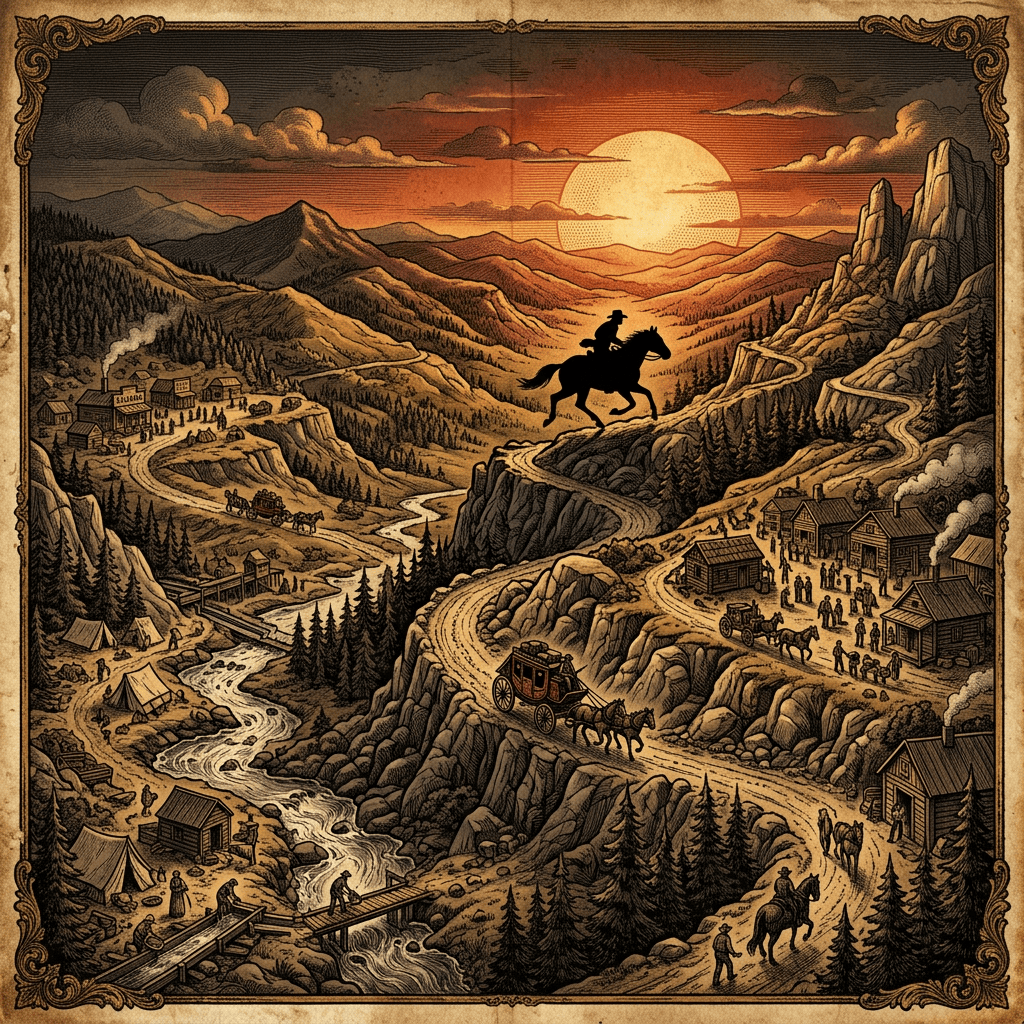
For one U.S. dollar, visitors to a San Francisco saloon in 1853 could stare directly into a glass jar filled with clear brandy and a severed human head.
The saloon owner swore the pickled head belonged to Joaquín Murrieta, California’s most feared outlaw—a man who had spent the previous three years terrorizing the Sierra Nevada foothills, stealing gold, and humiliating the state legislature. But to understand how a handsome young dream-seeker ended up as a macabre barroom attraction, we have to rewind the clock to 1849, back to the dusty, lawless goldfields where a revolution of resentment was born.
From Dreamer to Outlaw: The Spark in the Sierra
Before he was a phantom on horseback, Joaquín Murrieta Carrillo was just another optimistic eighteen-year-old following the glittering promise of wealth. Born in Sonora, Mexico, Murrieta married his sweetheart, Rosa Féliz, and joined the frantic tide of forty-niners heading north toward the newly acquired U.S. territory of California.
He was educated, polite, and skilled at working both gold pans and horses. But the California goldfields were far from a meritocracy.
The Treaty of Guadalupe Hidalgo had barely dried, ending the Mexican-American War in 1848, when hundreds of thousands of Anglo-American prospectors flooded the state. Tensions quickly boiled over. Anglo miners viewed Spanish-speaking prospectors—many of whom, like the Sonorans, possessed superior mining techniques—as foreign intruders stealing “American” gold.
In 1850, the California legislature passed the Foreign Miners’ Tax, levying a steep $20 monthly fee (nearly $700 in modern currency) targeted almost exclusively at Latino and Chinese miners. When taxes didn’t drive them away, vigilante violence did.
According to popular accounts and local lore, a group of American prospectors confronted Joaquín at his mining claim. They drove him off his land at gunpoint. He moved and tried farming; they drove him off again. When he was falsely accused of stealing a mule, an armed mob tied Joaquín to a tree and horsewhipped him, lynched his stepbrother, and violently assaulted his young wife.
Whether every detail of this brutal origin story was factual or magnified by popular storytellers, one reality was clear: the young miner who entered the Sierra foothills seeking a future left them seeking blood.
The Ghost of the Mother Lode: The Five Joaquíns
By 1851, the Sierra foothills were plagued by a phantom band of horse thieves, cattle rustlers, and highwaymen. Stagecoaches were ambushed, mining camps were raided, and white miners who had participated in vigilante violence began turning up dead in remote gulches.
At the center of the terror was a legendary figure named “Joaquín”.
The problem for local law enforcement was that every robbery from Yuba County down to Los Angeles was attributed to a man named Joaquín. In reality, the state was dealing with multiple distinct Mexican outlaw bands operating across hundreds of miles. Newspapers began reporting on “The Five Joaquins”—a syndicate supposedly led by Murrieta along with four co-captains: Joaquín Botellier, Joaquín Carrillo, Joaquín Ocomorenia, and Joaquín Valenzuela.
Riding alongside Murrieta was his brutal lieutenant, Manuel García, better known as Tres Dedos or “Three-Fingered Jack”—a man whose hatred of Anglo settlers was so fierce that even fellow bandits treaded lightly around him.
Together, the gang operated with breathtaking speed and stealth. They knew the hidden passes of the San Joaquin Valley, received shelter from sympathetic Californio ranchers, and struck without warning. Murrieta was said to distribute gold to struggling Mexican families who had been stripped of their land by squatters, earning him the title “The Robin Hood of El Dorado”.
Whether a cold-blooded killer or a vigilante freedom fighter, Murrieta had made a mockery of California’s infant legal system.
The Hunt and the Pickled Trophy
By May 1853, the California state government had seen enough. Governor John Bigler signed a special act authorizing the creation of the California State Rangers—a militia force of twenty veteran Mexican-American War combatants led by a towering former Texas Ranger named Harry Love.
Love and his rangers were offered a monthly salary and a state bounty of $6,000 for the capture of Joaquín Murrieta—dead or alive.
For two months, Love’s unit rode through the central valleys. On the morning of July 25, 1853, the Rangers surprised an encampment of armed Mexicans near Cantua Creek in the Panoche Pass. A fierce firefight broke out. Eight outlaws were killed, including Three-Fingered Jack and a handsome young man whom Love swore was Joaquín Murrieta himself.
To collect the $6,000 bounty, Love needed proof. In the July heat, transporting full bodies over hundreds of miles was impossible. The Rangers severed the head of the alleged Murrieta and the mutilated hand of Three-Fingered Jack, preserving both in glass vats of high-proof alcohol.
Love collected his reward after securing seventeen affidavits from individuals who claimed to recognize the dark-haired head in the jar. He then took the gruesome relic on a touring exhibit across California, charging spectators $1 a head to catch a glimpse of the fallen terror of the West.
Fact, Fiction, and the Birth of Zorro
Did Harry Love actually kill Joaquín Murrieta?
Even in 1853, many doubted it. Murrieta’s sister examined the pickled head and publicly stated it lacked her brother’s distinct scars. Sightings of Joaquín continued for years across California and Mexico, feeding whispers that Love had simply murdered an innocent vaquero to claim the state reward.
The head itself spent decades traveling between San Francisco side shows and museums until April 1806, when the great San Francisco earthquake and fire destroyed the building where it was stored, consuming the relic in flame.
While the physical head vanished, the legend exploded.
In 1854, a Cherokee-American journalist named John Rollin Ridge (writing under the pen name “Yellow Bird”) published The Life and Adventures of Joaquín Murieta, a heavily dramatized novel that cemented Murrieta as a romantic folk hero. Decades later, author Johnston McCulley drew directly on the Murrieta myth to create the black-masked swashbuckler Zorro.
Why This Still Matters
The story of Joaquín Murrieta endures because it isn’t just about a single bandit—it is a mirror held up to the tumultuous birth of modern California.
During the Gold Rush, the transition from Mexican territory to American statehood was marked by rapid displacement, racial violence, and legal disenfranchisement of native Californios and Latino immigrants. In this volatile environment, standard definitions of “outlaw” and “lawman” blurred.
To Anglo settlers, Murrieta was a bloodthirsty criminal who threatened the rule of law. To marginalized Spanish-speaking communities, he was a symbol of armed resistance against systemic oppression—a man who refused to be driven off his land without a fight. During the Chicano Civil Rights Movement of the 1960s and 70s, Murrieta was reclaimed as an icon of cultural pride and self-defense.
Whether he was a single man or an amalgamation of many, the legend of Joaquín Murrieta reminds us that history is often written by the victors—but the stories of those who fought back are the ones that endure.
Sources & SEO Metadata
Sources
- Ridge, John Rollin (Yellow Bird). The Life and Adventures of Joaquín Murieta, the Celebrated California Bandit. San Francisco: W.B. Cooke & Co., 1854.
- Burns, Walter Noble. The Robin Hood of El Dorado: The Saga of Joaquín Murrieta. New York: Coward-McCann, 1932.
- Secrest, William B. Joaquín: California’s Greenhorn Outlaw. Fresno: Saga Publishing, 1967.
- California State Archives. “California Rangers and the Capture of Joaquín Murrieta (1853)”.
- Encyclopædia Britannica. “Joaquín Murrieta: Legendary Mexican-American Bandit”.




Leave a comment