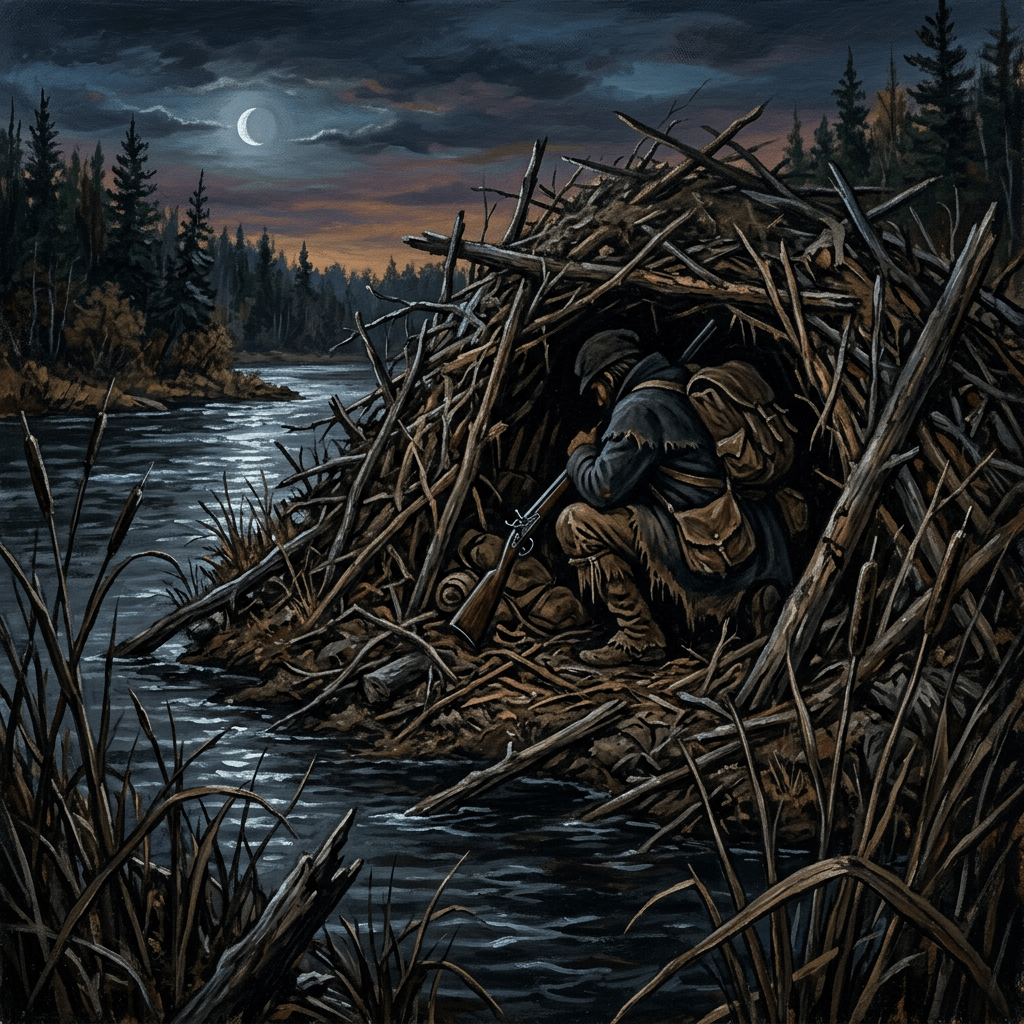
What if your survival depended on outrunning five hundred armed warriors across five miles of razor-sharp cactus, completely stark naked? Before John Colter was sprint-killing warriors and taking cover inside a muddy beaver lodge, he was just a man quietly paddling a dugout canoe down the Jefferson River, minding his own beaver traps.
To understand how a veteran of the Lewis and Clark Expedition ended up stripped of every stitch of clothing and running for his life across the Montana wilderness, we have to rewind to the autumn of 1809.
The Ambush at the Three Forks
In the early 1800s, the American West was not a peaceful expanse waiting to be charted; it was a patchwork of powerful sovereign nations, shifting alliances, and fierce rivalries. John Colter was no amateur. Having served honorably with Meriwether Lewis and William Clark from 1803 to 1806, Colter was a master woodsman, tracker, and survivor. When the Corps of Discovery headed back east toward civilization, Colter requested an early discharge so he could stay in the wilderness to trap beaver—the soft gold of the era.
By 1809, Colter was partnering with another former Lewis and Clark comrade, John Potts. The two trappers ventured deep into the territory around the Three Forks of the Missouri River—a region inhabited and fiercely defended by the Blackfeet Confederacy.
Knowing that the Blackfeet viewed white trappers with extreme hostility (partly due to a deadly clash with Captain Lewis’s party years earlier), Colter and Potts worked stealthily. They checked their traps at dawn, traveling silently along the river bends. But on a crisp morning along the Jefferson River, silence gave way to disaster.
A thundering sound echoed from the riverbank. Colter instinctively recognized it as a massive war party and urged Potts to retreat. Potts dismissed the noise as a herd of buffalo, but within moments, hundreds of Blackfeet warriors lined both sides of the river, weapons drawn, demanding the trappers come ashore.
A Fatal Choice and a Naked Verdict
Colter, reading the overwhelming odds, dropped his paddle, stepped ashore, and surrendered his rifle. He signaled for Potts to follow. Potts, however, panicked or simply chose defiance over surrender. Remaining in the canoe, Potts raised his rifle and shot one of the warriors.
The response was instantaneous and brutal. A hail of arrows riddled Potts’s body, killing him instantly. His corpse was dragged onto the bank and dismembered before Colter’s eyes.
Now alone, Colter expected immediate execution. Instead, the warriors disarmed him, stripped him completely naked, and took his boots. A tense council ensued among the leaders. Some wanted to tie Colter to a post for target practice; others argued for immediate death. But the chief had a far more sadistic entertainment in mind.
He stepped forward, grabbed Colter by the shoulder, and pointed toward the open prairie stretching out toward the Madison River. In broken trade jargon, he communicated the rules: Colter was given a head start of a few hundred yards. Then, hundreds of young, armed warriors would be unleashed to hunt him down.
It was “Colter’s Run”—a deadly game of cat and mouse where the mouse was stark naked, barefoot, and facing impossible odds.
The Ultimate Sprint for Survival
When the chief gave the signal, Colter didn’t hesitate. He burst into a full sprint across the sagebrush-covered plain.
The terrain was a nightmare. The ground was carpeted with prickly pear cactus, their needle-sharp spines piercing his bare feet with every stride. Adrenaline masked the agony. Pushing his body far beyond human limits, Colter ran toward the river, roughly five miles away.
For over three miles, Colter maintained a blistering pace, outrunning the main body of pursuers. Blood gushed from his nose and mouth from the extreme exertion and thin mountain air, yet he kept moving. Looking back over his shoulder, he noticed that the pack had strung out, but one lone warrior armed with a spear was closing in, just twenty yards behind.
Exhausted and knowing he couldn’t outrun the warrior forever, Colter stopped dead in his tracks, spun around, and threw his arms wide in defiance.
The sight of a naked, blood-soaked white man turning to fight startled the warrior. The warrior stumbled while trying to throw his spear, driving the shaft into the earth and breaking the spearhead. Before the brave could recover, Colter pounced. He seized the pointed iron spearhead, killed his attacker, grabbed the warrior’s blanket, and resumed his desperate dash.
Sanctuary in a Beaver Lodge
Reaching the riverbanks ahead of the main war party, Colter faced his next crisis: where could a naked man hide on an open riverbank from hundreds of angry searchers?
He spotted an island formed by a massive accumulation of driftwood and a submerged beaver lodge. Diving into the icy water, Colter swam beneath the floating debris and located the underwater entrance to the lodge. He popped his head up inside the air pocket above the water level—a cramped, dark space made of mud, sticks, and rotting vegetation.
For hours, Colter lay motionless in the darkness while warriors walked directly overhead on the logs, probing the water with spears and searching the shorelines. Fleas and mosquitoes tormented him, and the mountain runoff threatened to induce hypothermia, but Colter remained dead silent.
Only when darkness fell and the sounds of the search party vanished did Colter slip out of the lodge and swim quietly downstream.
Seven Days of Agony to Manuel Lisa’s Fort
Escaping the immediate vicinity of the Blackfeet was only half the battle. Colter was still hundreds of miles away from safety. He was naked, save for the captured blanket, with feet shredded by cactus spines and a body battered by extreme physical trauma.
Ahead lay a trek of over 200 miles across rugged mountain country to reach Fort Raymond (also known as Manuel Lisa’s Fort) at the mouth of the Bighorn River.
Without weapons, tools, or fire-starting gear, Colter survived for seven days by digging up edible roots, such as Psoralea esculenta (breadroot), and eating them raw. Sunburned by day, freezing by night, and walking on lacerated feet, he trudged across the wilderness through sheer willpower.
When a ghostly, emaciated figure stumbled through the gates of Fort Raymond a week later, the trappers inside could barely recognize him. John Colter had cheated death against impossible odds.
Why This Still Matters
The story of John Colter is more than an incredible wilderness survival tale; it represents a key chapter in Western history that shaped the trajectory of American expansion and mountain man lore.
- The Birth of Mountain Man Mythology: Colter’s escape cemented the legendary reputation of the American mountain man—individuals who possessed extraordinary resilience, adaptability, and psychological fortitude in uncharted regions.
- Early European-Native Conflict: The incident highlights the complex and often tragic geopolitical tensions between Indigenous nations defending their traditional hunting grounds and expanding fur trading interests.
- The Exploration of Yellowstone: Following his trapping expeditions, Colter became the first known person of European descent to explore the geothermal features of the Yellowstone region. When he described geysers and bubbling mud pots to people back east, they mocked him and dubbed the area “Colter’s Hell”—a region that would eventually become the world’s first national park.
- A Masterclass in Human Endurance: Colter’s feat remains a classic historical study in emergency survival, extreme athleticism, and the innate human instinct to survive against overwhelming odds.
Sources
- Bradbury, John. Travels in the Interior of America in the Years 1809, 1810, and 1811. (Firsthand account recorded directly from John Colter in 1810).
- Ambrose, Stephen E. Undaunted Courage: Meriwether Lewis, Thomas Jefferson, and the Opening of the American West. Simon & Schuster, 1996.
- National Park Service. “John Colter and the Yellowstone Area.” U.S. Department of the Interior.
- Montana Historical Society. “Colter’s Run and the Fur Trade Era at Three Forks.” Montana: The Magazine of Western History.


 History in 5 Minutes or less
Leave a comment