Did you know that the executioner’s rope snapped the first time they tried to hang Captain William Kidd, leaving him gasping in the mud while the crowd screamed for his blood? Before we get to that grim, muddy scaffold in London in 1701, we have to rewind to a time when William Kidd wasn’t a notorious pirate at all, but a respected, wealthy New York gentleman who made the ultimate mistake: taking a job for the King of England.
This is the true story of how an honest privateer became history’s most famous pirate, how a real buried treasure sparked a global frenzy, and why people are still searching for his lost gold today.
The Pillar of the Community: A Gentleman’s Rise
Before he was branded the terror of the high seas, William Kidd was a pillar of 17th-century Manhattan society. Born in Dundee, Scotland around 1654, Kidd migrated to New York City, where he built a comfortable life. He was a skilled sea captain, a wealthy landowner, and a brave privateer who helped defend English trade routes against French privateers. He was so well-regarded that he even contributed runner rigging to help build the steeple of Trinity Church in Wall Street.
Kidd married Sarah Bradley Cox Oort, one of the wealthiest women in New York. He wore fine silks, lived in a grand house overlooking the harbor, and was respected by colonial governors. But luxury breeds ambition, and ambition, as Kidd would soon discover, can be fatal.
In 1695, while visiting London, Kidd met Bellomont—the newly appointed Governor of New York and Massachusetts. Bellomont introduced Kidd to an elite group of English nobility, including the Earl of Orford and the First Lord of the Admiralty. They had a proposal for Captain Kidd, one that promised unimaginable wealth: a privateering syndicate.
The pitch was simple: Kidd would sail to the Indian Ocean aboard a state-of-the-art warship called the Adventure Galley. His mission was twofold: capture any French ships he could find (England was at war with France) and hunt down rogue pirates who were disrupting the lucrative East India Company trade.
There was just one catch. This was a private business venture funded by the nobility, including King William III himself (who held a 10% share off the record). If Kidd returned empty-handed, he would be ruined. If he succeeded, he and his investors would share a fortune.
Curses, Fevers, and Mutiny: The Disaster at Sea
In September 1696, Captain Kidd set sail on the Adventure Galley, a formidable 287-ton vessel equipped with 34 cannons and 23 oars (to maneuver in dead calm). But the voyage was cursed from the start.
While leaving London, Kidd allegedly failed to salute a Royal Navy yacht in the Thames, as was custom. When the Navy crew fired a shot across his bow to demand respect, Kidd’s crew insolently flipped their rear ends at the Navy ship. The Royal Navy retaliated by pressing many of Kidd’s finest, disciplined crewmen into navy service, leaving Kidd forced to fill his roster in New York with desperate sailors, ex-pirates, and vagrants.
By the time the Adventure Galley reached the Indian Ocean in early 1697, cholera and fever swept through the ship, killing dozens of men. Months passed, and Kidd found no pirate ships or French prizes. His crew grew restless, hungry, and mutinous. They were paid on a “no purchase, no pay” basis; without loot, they were starving.
Desperate to maintain control, Kidd’s temper boiled over in October 1697. During a heated argument on deck with his gunner, William Moore, who demanded they attack an innocent Dutch ship, Kidd snapped. He snatched up an iron-hooped wooden bucket and struck Moore over the head. Moore died the next day from a fractured skull.
Kidd had killed a crewman in cold blood. The line between lawful privateer and desperate outlaw was dissolving fast.
The Fatal Prize: The Quedagh Merchant
In January 1698, off the coast of India, Kidd’s fortunes seemed to turn. He spotted a massive, heavily laden 400-ton vessel called the Quedagh Merchant. The ship belonged to Armenian merchants, was captained by an Englishman, but carried a French pass for protection.
Since England was at war with France, holding a French pass technically made the ship a legal target for a privateer. Kidd swooped in and captured the prize without firing a shot.
The Quedagh Merchant was a treasure trove: loaded with gold, silver, rich silks, muslins, sugar, opium, and iron. The total haul was worth roughly £70,000—millions of dollars in today’s currency. Kidd thought his troubles were over. He was rich, his crew was satisfied, and his noble investors back in London would receive their massive payout.
He couldn’t have been more wrong.
Unbeknownst to Kidd, the cargo aboard the Quedagh Merchant belonged in part to Mukhtar Khan, a powerful grandee of the Mughal Empire. Outraged by the piracy, the Mughal Emperor threatened to shut down the East India Company’s operations entirely unless the British brought the pirate responsible to justice.
Suddenly, Captain William Kidd was not a hero. He was a political liability of global proportions. To protect their corporate profits and diplomatic ties, the East India Company and the British Government declared William Kidd a wanted pirate.
The Birth of the Buried Treasure Legend
When Kidd arrived at Madagascar in April 1698, his situation collapsed completely. The notorious pirate Robert Culliford was anchored nearby. Instead of attacking Culliford, most of Kidd’s mutinous crew abandoned him to join the pirates, taking the bulk of Kidd’s looted goods with them.
Left with only a handful of loyal men, an unseaworthy Adventure Galley, and the captured Quedagh Merchant, Kidd burned the Adventure Galley and set sail for the Caribbean aboard the Quedagh Merchant.
Arriving in the West Indies in early 1699, Kidd was stunned to learn that he had been officially branded a pirate across the British Empire. Confident he could clear his name by producing the French passes from his prizes, Kidd abandoned the heavy Quedagh Merchant in a hidden bay in Hispaniola (today’s Dominican Republic) and purchased a smaller sloop, the Antonio.
He loaded the Antonio with gold, silver, jewels, and high-value goods, sailing north toward New York to negotiate with his patron, Lord Bellomont.
Knowing that carrying a mountain of gold into harbor while wanted for piracy was dangerous, Kidd made a historic move. In June 1699, he dropped anchor off Gardiners Island, a private island near the eastern tip of Long Island, New York.
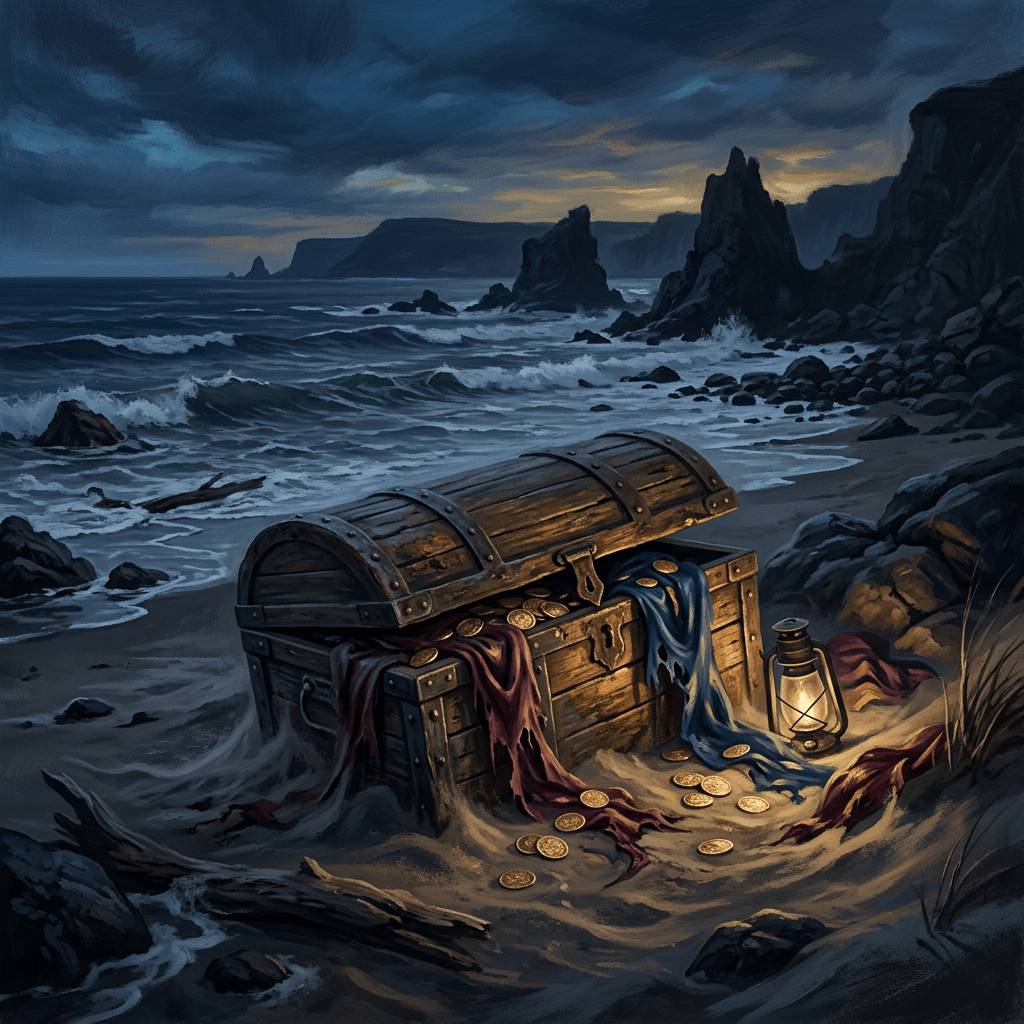
With the permission of the island’s owner, John Gardiner, Kidd buried a substantial portion of his chest—filled with gold dust, bar gold, Spanish dollars, silver, and precious rubies—in a ravine on the island. He gave Mrs. Gardiner a piece of cloth-of-gold as a gift and told Gardiner that if the treasure was missing when he returned, he would pay with his life.
This single act would ignite three centuries of global treasure hunting legend. William Kidd had buried real pirate treasure.
Trapped in Boston and Betrayed
Armed with his buried bargaining chip, Captain Kidd sailed into Boston in July 1699 to meet Lord Bellomont. Kidd believed his political friends would protect him once he handed over the treasure and showed them the French passes proving his innocence.
He miscalculated horribly.
Lord Bellomont was terrified of being linked to a branded pirate, which would destroy his own political career and disgrace his noble peers in London. Bellomont feigned friendship until he lured Kidd into a trap. On July 6, 1699, Kidd was arrested and thrown into a cold, damp Boston jail in leg irons.
Bellomont immediately ordered a search for Kidd’s assets. Government officials raided Gardiners Island and recovered the buried cache. According to official records, they unearthed:
- 1,111 ounces of gold
- 2,353 ounces of silver
- 57 green stones and rubies
- Bales of silk and satin
Totaling over £14,000, this recovered loot was dispatched to London as evidence. But rumors spread immediately: was this all of Kidd’s treasure? What about the massive cargo left aboard the Quedagh Merchant in Hispaniola? What about secret caches along the Atlantic coast?
The Trial and Execution: A Fixed Game
In 1700, Kidd was shipped to England in chains to stand trial. Locked away in Newgate Prison, he fell ill and grew increasingly desperate.
His trial at the Old Bailey in May 1701 was a complete sham by modern legal standards. Kidd was denied legal counsel to represent him during the trial. Crucially, the French passes he had taken from the captured ships—the primary evidence that could prove he was acting legally as a privateer—mysteriously vanished from the Admiralty files (they were hidden by political figures to ensure his conviction).
Without the passes, Kidd could not defend himself against charges of piracy. To make matters worse, he was also charged with the murder of his gunner, William Moore.
Kidd pleaded his innocence to the end, stating: “I have been sworn against by perjured and wicked people.”
On May 23, 1701, William Kidd was led to Execution Dock in Wapping, London. The executioner placed the noose around his neck, turned the ladder, and dropped him—but the rope snapped under his weight, dropping Kidd into the mud below.
While the breathless captain was dragged back up the scaffold, the executioner prepared a second rope. This time, it held.
After his death, Kidd’s body was dipped in tar and bound in iron chains, hung in a gibbet over the River Thames at Tilbury Point. His corpse remained suspended there for years as a gruesome warning to anyone considering a life of piracy on the high seas.
The Lost Treasure: Fact vs. Fiction
The executioner’s rope ended Captain Kidd’s life, but it birthed an indestructible legend.
Before his death, Kidd allegedly wrote a desperate letter to the House of Commons offering to lead a ship to hidden treasure worth over £100,000 in exchange for his life. The letter was ignored, but the public became obsessed with the idea of “Kidd’s Cache.”
Over the next 300 years, treasure hunters combed every beach, island, and inlet from the Caribbean to Canada.
| Alleged Location | Legend / Discovery | Modern Status |
| Gardiners Island, NY | Only verified buried treasure location. | Recovered by colonial government in 1699. |
| Oak Island, Nova Scotia | Famous “Money Pit” rumored to hold Kidd’s hoard. | Unproven; billions spent searching. |
| Block Island, Rhode Island | Legend says Kidd stayed and buried silver here. | Popular local lore; no gold found. |
| Thimble Islands, Connecticut | Money Island rumored to hide gold in sea caves. | Never verified. |
| Santa Catalina Island, Dominican Rep. | Scuttled remains of the Quedagh Merchant. | Discovered in 2007 by Indiana University archaeologists! |
In 2007, maritime archaeologists from Indiana University made a historic discovery off Catalina Island in the Dominican Republic. In less than 10 feet of clear water, they discovered the submerged wreckage of the Quedagh Merchant. The cannons and anchors matched the historical ship Kidd had abandoned in 1699.
While no gold coins remained—the crew and local scavengers had long since stripped the ship before it burned—it confirmed that Captain Kidd’s story was built on real ships, real treasure, and real history.
Why This Still Matters
The story of Captain William Kidd is far more than a colorful pirate yarn; it is a foundational moment in global legal, political, and cultural history.
- The Origin of Pirate Lore: Captain Kidd is the primary reason we associate pirates with buried treasure. While most real historical pirates spent their loot instantly in port, Kidd’s unique political predicament forced him to bury his wealth. Without Kidd, classics like Robert Louis Stevenson’s Treasure Island and modern blockbusters like Pirates of the Caribbean would not exist in the form we know today.
- Corporate and Political Scapegoating: Kidd’s trial remains a textbook example of political cover-ups. Wealthy power-brokers used a private contractor to do their dirty work, reaped the profits when things went well, and sacrificed him to protect corporate interests (the East India Company) when geopolitics soured.
- Modern Underwater Archaeology: Discoveries like the Quedagh Merchant shipwreck in 2007 show how historical archaeology bridges the gap between legend and fact. Today, the wreck is preserved as a “Living Museum of the Sea,” protecting marine life while offering divers a direct connection to pirate history.
Sources & Historical References
- Ritchie, Robert C. Captain Kidd and the War against the Pirates. Harvard University Press, 1986.
- Zacks, Richard. The Pirate Hunter: The True Story of Captain Kidd. Hyperion, 2002.
- Indiana University Office of Communications. “IU archaeologists discover shipwreck of Captain Kidd.” Indiana University Newsroom, 2007.
- The National Archives (UK). High Court of Admiralty Records: The Trial of Captain William Kidd (1701).






Leave a comment